

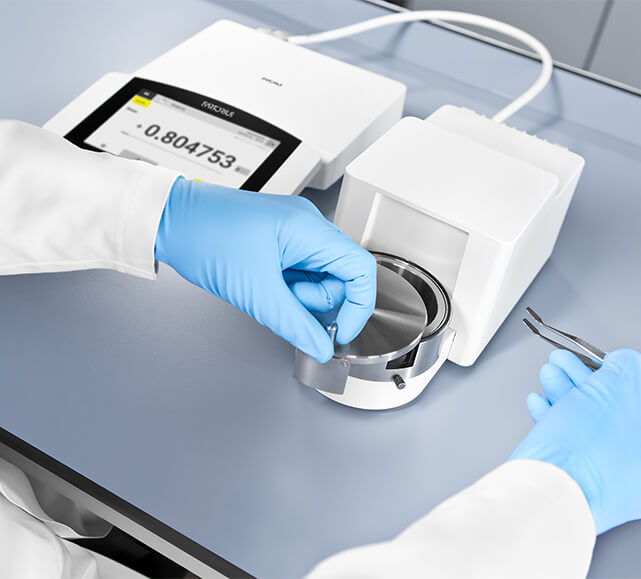
Ultra Micro Balances
Ultra Micro Balance Features
Maximum weighing capacity: 2.1 g, readability: 0.1 μg. M-type draft shield: automatic motorized circular glass draft shield with learning capability, illumination, and integrated motion sensor. F-type draft shield: manual stainless steel draft shield for filter weighing applications. Integrated QApp Center for software-guided workflows (available with MCA display). The Status Center displays all balance-related information (available on MCA display).
Advantages of Ultra Micro Balances
Sartorius titanium weighing pans eliminate the influence of magnetic fields, providing improved repeatability and accuracy. The illuminated weighing chamber enhances visibility and ensures safe sample dosing. Sample holders (e.g., tubes with secure locking mechanisms and holders for filter applications) support ergonomic sample weighing and simplify weighing workflows. The integrated motion sensor enables touch-free opening and closing of the draft shield.
Our Ultra Micro Balance Services
The demand for compliant, reliable, and accurate laboratory data continues to increase across all industries. With our certified and accredited services, we support and maintain your laboratory weighing equipment throughout its entire lifecycle. We help ensure the longevity of your equipment, minimize downtime to reduce production losses, and enable faster, more consistent, and repeatable results.
- Categories: Laboratory Balances | Laboratory Balances |
What Are Ultra Micro Balances Used For?
Ultra micro balances are used to weigh the smallest sample quantities with a readability of 0.1 µg. These balances are frequently used in filter weighing applications, such as environmental testing. By measuring the initial and final weights of filters, even the smallest amounts of retained particles can be determined. Another application is weighing stents to determine the quantity of extremely thin chemical coatings applied to them.
How Can You Achieve Optimal Weighing Results?
Step 1: Choose a stable weighing table in a quiet location for installing your balance.
Step 2: Work under consistently stable environmental conditions in the laboratory.
Step 3: Ensure that the balance is properly leveled and calibrated.
Why Is Measurement Uncertainty Important?
Modern high-performance laboratory balances support users with impressive practical and regulatory functionalities. However, these balances are complex and highly sensitive measuring instruments. Depending on the device, factors such as installation location and user expertise can significantly influence the displayed results.
How Does Magnetism Affect Weighing?
Despite the many beneficial applications of magnetism, it is highly undesirable during weighing processes. Weighing magnetic materials or magnetizable tare containers and samples can affect balance stability and compromise measurement repeatability.
What Characteristics Should an Ideal Laboratory Balance Table Have?
High-density materials such as marble and engineered stone absorb low-frequency vibrations that may negatively affect balance performance. Their substantial weight also provides a stable support structure. Special weighing tables designed specifically for laboratory balances are highly recommended, particularly for high-resolution balances. A stone table equipped with anti-vibration damping is considered the best option.