

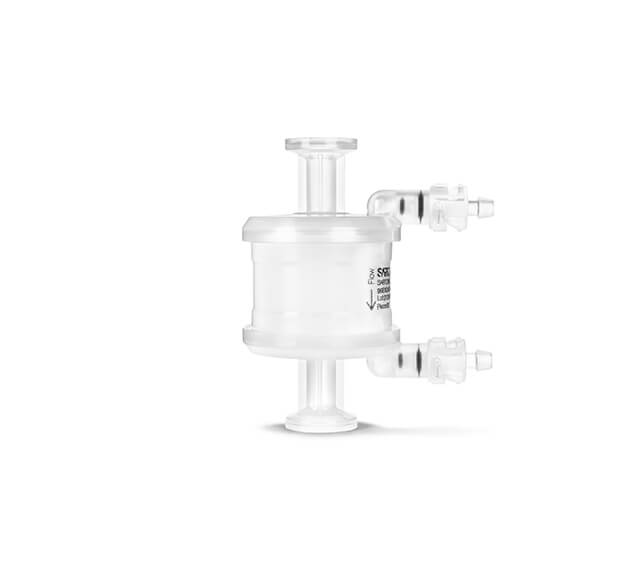
Sartobind STIC® PA Mini
The new Sartobind STIC® PA Mini provides a 10 mL membrane volume, making scale-up easier for bioprocess customers and offering an excellent fit for the production of diagnostic products. Sartobind® Mini is directly scalable to the existing Sartobind® portfolio, from process development (Nano) through commercial manufacturing.
- Categories: Process Chromatography | Chromatography Consumables | Chromatography Membranes | Sartobind® IEX Membranes | Sartobind STIC® PA |
Sartobind STIC® PA removes impurities under high-salt conditions. Salt-Tolerant Interaction Chromatography (STIC) with the PA ligand is based on the principles of Anion Exchange Chromatography (AEX). AEX is a well-established method for removing process-derived impurities such as host cell proteins (HCPs), DNA, endotoxins, and adventitious or endogenous viruses. It is performed in flow-through mode during downstream processing of monoclonal antibodies (mAbs).
Because the process is throughput-limited rather than capacity-limited, membrane chromatography (MC) offers advantages over columns, as membranes can operate at flow rates up to two orders of magnitude higher. Membranes are easy to use and can be disposed of after a single use, reducing validation costs.
Applications
Current mAb downstream processes include at least one initial capture step and one AEX chromatography step. A limitation of traditional Q chemistry is the requirement for low-salt conditions.
In processes where cation exchange chromatography (CEX) is used as a second chromatography step, the CEX pool must be diluted to conductivities of 4–7 mS/cm to re-establish binding conditions for the subsequent AEX step.
The Sartobind STIC® PA membrane consists of cross-linked regenerated macroporous cellulose. The primary amine ligand is attached to the matrix at a ligand density approximately six times higher than that of the Q membrane. Both the free amine and the high ligand density were critical for achieving high salt tolerance.
Benefits
- No dilution of CEX pools required
- Up to 10 kg/L host cell proteins (product load per liter of membrane)
- Virus removal > 4 log
- DNA removal up to 1.5 M NaCl
- Endotoxin removal > 4 log
Easy to Use
- Plug-and-play devices from 0.08 mL to 1.6 L
- Can be used like a filter
- Flow rates up to 30 bed volumes per minute
- Disposable after a single use