

Sartobind® Phenyl
Sartobind® Phenyl is a hydrophobic interaction membrane with low ligand substitution density. This enables gentle elution conditions for the purification of all biomolecules.
Sartobind® Phenyl membranes can replace columns in polishing (flow-through) operations and a variety of bind-and-elute applications, as they operate at much higher flow rates, with reduced complexity and without size exclusion effects during the purification of large biomolecules.
- Categories: Process Chromatography | Chromatography Consumables | Chromatography Membranes | Sartobind® HIC Membranes |
Hydrophobic Interaction Chromatography (HIC) separates and purifies biomolecules based on differences in their hydrophobicity. The Phenyl membrane adsorber follows the same principles known from traditional hydrophobic interaction chromatography.
Due to its large pore size, membrane adsorbers exhibit excellent flow characteristics. Compared with conventional bead chromatography, there are virtually no diffusion limitations in mass transfer.
High-salt buffers promote the adsorption of proteins onto the hydrophobic membrane matrix. Proteins are then eluted by reducing the salt concentration in the elution buffer.
The salt dependence of the membrane is comparable to that of columns using ammonium sulfate, sodium chloride, or sodium citrate.
Applications
HIC is a powerful method for distinguishing target proteins from hydrophobic impurities. Large proteins bind more strongly than smaller proteins, and aggregates bind significantly better than monomers due to multipoint interactions.
Typically, a high ionic-strength buffer such as ammonium sulfate is initially added to the protein solution. Salt ions reduce the solubility of solutes in the sample. As solubility decreases, exposed hydrophobic regions are adsorbed onto the hydrophobic membrane matrix.
In the HIC membrane, flexible cellulose is used as the backbone for the phenyl ligand. The membrane can be regenerated using water or alcohol.
The HIC membrane is used for the removal of:
- Aggregates
- Host cell proteins (HCPs)
- Viruses
- Endotoxins
- Lipids, dyes, detergents, and antifoaming agents
- Leached chromatography ligands
The Phenyl membrane can also be used for binding large biomolecules such as:
- Monoclonal antibodies
- Conjugate vaccines, viruses, and bacteriophages
- Oligonucleotides
Benefits
HIC membranes offer the following advantages over traditional HIC columns:
- Excellent aggregate reduction
- Up to 85% buffer savings
- Up to 75% time savings
Ease of Use
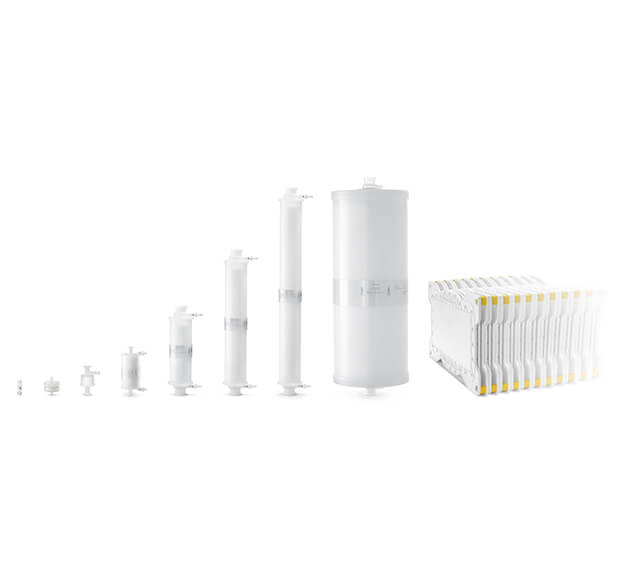
- Plug-and-play devices from 0.08 mL to 5 L
- Can be used like a filter
- Flow rates up to 5 bed volumes per minute
- Reusable for more than 100 cycles or available as disposable units