

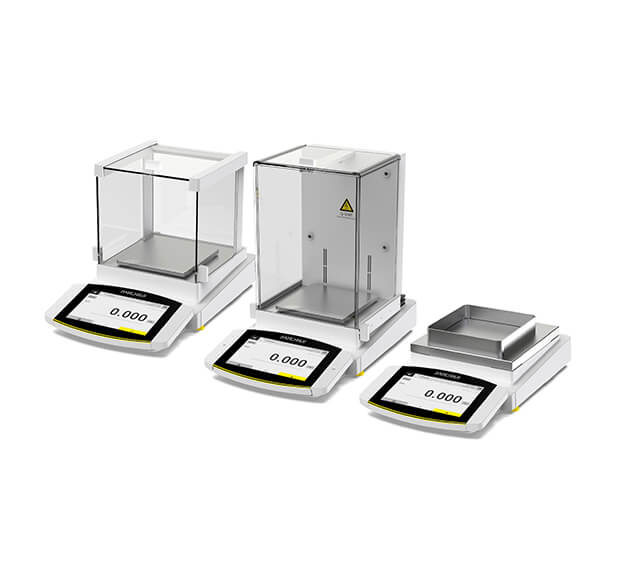
Precision Balances
Analytical Balance and Precision Balance
An analytical balance is more accurate than a precision balance. While an analytical balance has a readability of 0.1 mg (0.0001 g), a precision balance typically offers a readability of ≥1 mg (≥0.001 g). Therefore, an analytical balance provides at least 10 times higher resolution compared to a precision balance.
Design Types
Precision balances with a readability of 1 mg (milligram balances) are typically equipped with a three-door glass draft shield, either manual or automatic, and a weighing pan size ranging from Ø115 mm to 140 × 140 mm.
Balances with a readability from 10 mg up to 1 g, often referred to as precision or top-loading balances, usually feature an open weighing pan without a draft shield. The weighing pan is made of stainless steel and typically ranges from Ø180 mm to 206 × 206 mm in size.
Analytical Balance vs Precision Balance
An analytical balance offers higher accuracy than a precision balance. Analytical balances provide a readability of 0.1 mg (0.0001 g), whereas precision balances typically provide ≥1 mg (≥0.001 g). This means analytical balances deliver at least 10 times higher resolution.
- Categories: Laboratory Balances | Laboratory Balances |
How Much Calibration Weight Is Required for Precision Balances?
Sartorius recommends a three-point calibration for daily checks:
- A weight above 80% of maximum capacity
- A weight at the minimum usable range
- A weight close to typical sample size used on the balance
How Often Should Internal Adjustment Be Performed on a Precision Balance?
Automatic adjustment is preferred so the balance remains continuously adapted to its environment. If the balance has not been adjusted for some time and is about to be used, a manual internal adjustment is acceptable.
How Often Should isoCAL Be Performed?
isoCAL is triggered either when environmental conditions change or at fixed intervals depending on readability:
- For 4, 5, 6, and 7-digit resolutions: every 4 hours
- For lower-resolution instruments: every 6 hours