

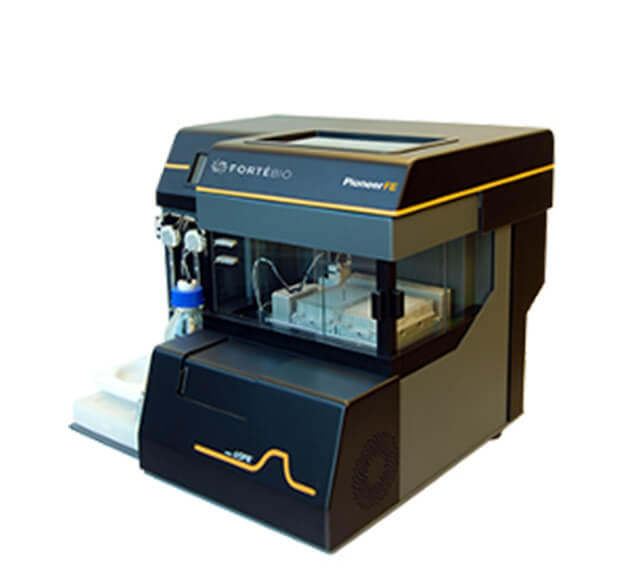
Pioneer FE SPR System
High-Throughput SPR for Fragment-Based Drug Discovery
High-Throughput Fragment-Based Drug Discovery – The Pioneer FE system includes a high-throughput mode capable of determining kinetic and affinity values for up to 768 analytes within 24 hours. Dedicated system software includes a hit-selection feature for normalization, merging, and analysis of fragment or other screening datasets, enabling accurate identification of promising candidates.
Simplified Kinetic Characterization – With OneStep injections, users can obtain accurate kinetic and affinity values from a single analyte concentration injection, eliminating the need for multiple analyte titration runs. This saves time and reduces errors associated with preparing serial dilutions. NextStep injections provide a simple workflow for characterizing competitive binders against a ligand to capture the mechanism of action.
Low Baseline Noise, Minimal Drift, High Sensitivity, and Data Acquisition Rates up to 40 Hz – Extremely low baseline noise and drift enable reliable measurement of kinetic and affinity values, even for high-affinity and challenging binders. With data acquisition rates of up to 40 Hz, Pioneer FE systems can capture the very rapid association and dissociation phases of a wide range of biomolecules and small-molecule fragments.
- Categories: Protein Analysis | OneStep SPR Systems |
Pioneer SPR systems provide high-quality kinetic data (ka, kd) and affinity measurements (KD) for characterizing a wide range of biomolecular interactions, from small-molecule fragments to biologics. OneStep SPR injections enable faster assay workflows, as a single analyte concentration is sufficient for accurate kinetic and affinity determination.
Three-Channel, Fully Automated SPR System
With three detection channels, two target proteins or ligands can be analyzed simultaneously while a third surface serves as a reference channel.
Up to 72 Hours of Unattended Operation
The system supports a variety of sample container formats, including a capacity of up to two 384-well plates, providing approximately 72 hours of unattended runtime for large-scale binding screens.
Rapid Data Analysis with QDat Software
Pioneer SPR systems are equipped with integrated, industry-proven data analysis software based on the Scrubber and Clamp platforms. Raw data collected across multiple runs, days, and sensors can be combined and analyzed using binding algorithms such as single-site, multi-site, mass transport, and irreversible inhibitor analysis models.
Gain More Information from Less Data
Because an analyte gradient is generated during OneStep injections, a diffusion coefficient can be calculated, providing users with information not only about kinetics and affinity but also an assessment of aggregation from a single injection.
Robust Fluidics Design
The Pioneer fluidics system is constructed from inert materials such as PEEK, ceramic, and Tefzel, ensuring durability and low maintenance requirements.
Applications
Characterization of High-Affinity Biological Interactions
Target binding characterization is a critical analytical step for selecting highly specific biologics with high affinity (KD < 1 nM), regardless of molecular type. Kinetic analysis provides a more detailed understanding of the association and dissociation components that contribute to overall affinity. For example, two lead compounds may exhibit similar affinity values (KD), but differences in association and dissociation rate constants can help predict which candidate will perform better in vivo. Accurate analysis of these kinetic rate constants is essential for lead selection and for predicting the efficacy of protein therapeutics.
With next-generation SPR injections, the Pioneer SPR system determines kinetics and affinity in a single step, significantly improving the efficiency of the characterization process compared to traditional SPR methods. The next-generation OneStep gradient injection technology included in the Pioneer platform greatly accelerates affinity characterization while maintaining high accuracy and confidence in the results.
Characterizing Irreversible Inhibitors and Measuring Covalent Engagement
Most small-molecule inhibitor assays evaluated using label-free, real-time biosensor technologies involve reversible interactions characterized by commonly used kinetic rate models. However, a significant proportion of therapeutic enzyme inhibitors on the market function through covalent modification of their targets.
Pioneer is an SPR platform compatible with regenerable Streptavidin biosensors, enabling oriented capture of protein targets and measurement of the efficiency of covalent inhibitors binding to those targets. The Pioneer system’s irreversible inhibitor application method can be used to determine covalent commitment (Cc) of an inhibitor compound, providing an important metric for evaluating irreversible inhibitors.