

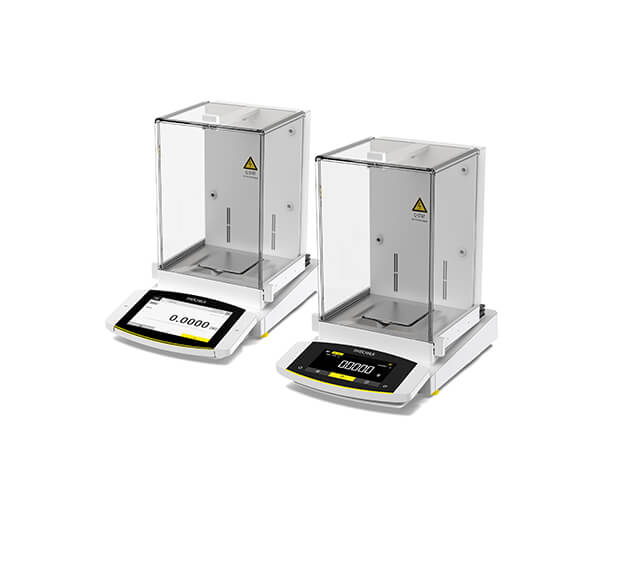
Analytical Balances
Highly sensitive laboratory balances designed for weighing applications, typically featuring an enclosed weighing chamber to prevent the effects of dust and air currents. They offer options for vibration resistance, data transfer, automation, and a wide range of weighing capacities.
Why Choose an Analytical Balance?
Analytical balances are among the most commonly used balances in laboratories. They offer maximum weighing capacities ranging from 60 g to 520 g and a readability of 0.1 mg, making them ideal for weighing small samples. In some cases, laboratory balances with a readability of 0.01 mg or 10 µg are also classified as analytical balances. Specialized weighing pans, sample holders, and software applications are available to meet the requirements of specific applications, simplify weighing procedures, and streamline laboratory workflows.
Analytical Balance vs. Precision Balance
An analytical balance provides greater accuracy than a precision balance. While an analytical balance offers a readability of 0.1 mg (0.0001 g), a precision balance typically provides a readability of ≥1 mg (≥0.001 g). As a result, an analytical balance delivers at least ten times greater readability than a precision balance.
- Categories: Laboratory Balances | Laboratory Balances |
What Is an Analytical Balance?
Analytical balances are precision laboratory instruments designed to measure mass accurately. Their readability is typically 0.1 mg. In some cases, semi-micro balances with a readability of 0.01 mg are also included in this category. Analytical balances are generally equipped with a draft shield to prevent air currents from affecting the weighing process.
How Often Should an Analytical Balance Be Calibrated?
Regular monitoring and calibration of your analytical balance are essential. Automatic internal calibration (isoCAL) can be used, but it is also recommended to perform calibration using certified external weights.
The frequency of external calibration depends on several factors, including:
Frequency of use:
Balances used daily should be calibrated more frequently than those used weekly. If a balance is used every day, calibration should be performed at least once daily.
Changing environmental conditions:
If the balance is exposed to varying environmental conditions or is located near sources of vibration, air conditioning systems, windows, doors, or similar influences, more frequent calibration is recommended.
Importance of weighing accuracy:
The higher the required accuracy, the more frequent the calibration should be.
Transportation and relocation:
A balance should always be calibrated after being moved. Gravity is not identical everywhere on Earth, and geographical location, altitude, and orientation relative to the Earth's magnetic and gravitational fields can cause slight variations. Since balances measure mass through gravitational force, relocating a balance, even to another floor of the same building, may affect measurement results and require recalibration.
What Are Analytical Balances Used For?
Analytical balances combine high measurement precision with short measurement times of only a few seconds. They are widely used for routine laboratory applications, including:
- Back-weighing procedures
- Accumulation and averaging applications
- Dosing operations
- Sample preparation for subsequent analytical processes
How Do You Select the Correct External Calibration Weight?
Determine the number of display divisions based on the resolution of your weighing instrument and then consult the appropriate accuracy class chart for the required calibration weight.
The nominal mass value of the calibration weight should exceed 80% of the maximum capacity of the weighing instrument.
Example:
If your balance has a maximum capacity of 2,200 g and a readability of 0.01 g, this corresponds to 220,000 display divisions. In this case, an E2 class calibration weight is recommended, and a nominal mass value of 2,000 g should be selected.
What Is the Best Way to Clean an Analytical Balance?
Place the balance in standby mode and perform all necessary cleaning procedures carefully, ensuring that no residue remains on the weighing pan. Once cleaning is completed, recalibrate the balance and perform the routine daily verification check.
How Is Weighing Performed for Pharmaceutical Industry Applications?
Sartorius laboratory balances are designed to comply with U.S. FDA data integrity requirements, ensuring that data is Accurate, Legible, Contemporaneous, Original, and Attributable (ALCOA).